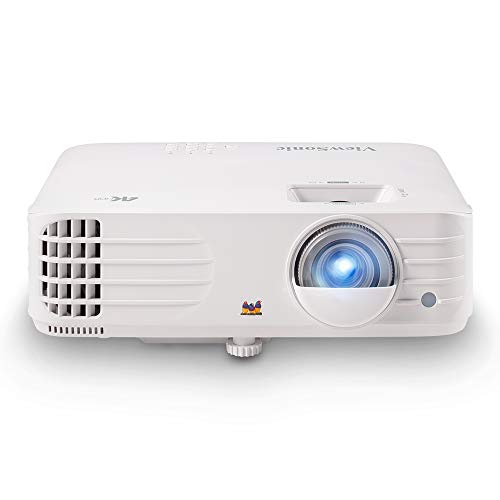
12 projectors tested and ranked across every price tier. Whether you want cinematic 4K, lag-free gaming, or the best value under $500, we have a pick for you.
Use our calculators to match a projector to your room before you buy.
We spent months testing projectors from BenQ, Epson, Optoma, and ViewSonic in real home theater environments. Below are 12 models that stood out - organized by price tier so you can jump straight to your budget.
| Pick | Projector | Resolution | Lumens | Price |
|---|---|---|---|---|
| Best Overall | BenQ HT3560 | 4K | 2,200 | $1,500-$1,800 |
| Best 4K Gaming | BenQ TK860i | 4K | 3,300 | $1,300-$1,600 |
| Best 4K Value | BenQ TK850 | 4K | 3,000 | $1,100-$1,400 |
| Best Short Throw 4K | Optoma UHD35STx | 4K | 3,600 | $1,000-$1,300 |
| Best ST Gaming | Optoma GT2100HDR | 1080p | 4,200 | $1,000-$1,300 |
| Best Under $1K | Epson Home Cinema 2350 | 4K PRO-UHD | 2,800 | $800-$1,000 |
| Best Budget 4K | ViewSonic PX701-4K | 4K | 3,200 | $700-$900 |
| Best 1080p | BenQ HT2060 | 1080p | 2,300 | $700-$850 |
| Best Budget Gaming | BenQ TH685P | 1080p | 3,500 | $600-$750 |
| Best Under $600 | Optoma HD146X | 1080p | 3,600 | $500-$700 |
| Best Value 1080p | BenQ TH575 | 1080p | 3,800 | $400-$550 |
| Budget Pick | Epson Home Cinema 880 | 1080p | 3,300 | $400-$550 |
At this tier you get true cinematic performance - wide color gamuts, refined HDR tone mapping, and the kind of image quality that makes you forget you are watching a projection.
Our top pick for movies, delivering 100% DCI-P3 color coverage and HDR-PRO tone mapping that rivals projectors costing twice as much. The dynamic iris pushes contrast past 30,000:1, producing rich blacks and stunning shadow detail in dark rooms. Vertical and horizontal lens shift makes installation flexible without image-degrading keystone correction.
Splits the difference between home theater and gaming with 3,300 lumens for ambient-light rooms and built-in Android TV for streaming. Delivers 4K at 60Hz or 1080p at 120Hz with ~16ms input lag, making it responsive enough for all but competitive FPS players. Smart Eye Care adjusts brightness automatically during long sessions.
This is where 4K performance meets reasonable pricing. You sacrifice some of the color refinement of the premium tier, but gain brightness, gaming features, and short throw options that the pricier models do not always offer.
A proven all-rounder combining 4K resolution, 3,000 lumens, and HDR-PRO tone mapping with 98% Rec.709 color coverage. Bright enough for rooms with ambient light yet detailed enough for dark-room movie nights, with a sports mode that actually delivers. The 1.3x zoom and vertical lens shift keep installation flexible in medium-sized rooms.
Produces a 100-inch 4K image from just 4 feet, ideal for apartments and smaller rooms where a long throw distance is not an option. At 3,600 lumens it handles ambient light better than anything else in this tier. Also doubles as a gaming projector with 240Hz at 1080p and a 4.2ms response time.
Trades 4K for a laser light source with 4,200 lumens and a 30,000-hour lifespan -- zero lamp replacements and consistent brightness for a decade. Dominates bright rooms and even handles outdoor evening use. Short throw optics plus HDR support make it a weapon for immersive big-screen gaming in tight spaces.
This tier is where most people should start shopping. You get genuinely impressive image quality - including entry-level 4K - without spending more than a decent TV would cost. The competition at this price has driven quality remarkably high.
Epson's 3LCD technology eliminates the DLP rainbow effect entirely while delivering 4K PRO-UHD pixel-shifting and built-in Android TV for streaming out of the box. The 2,800 lumens output handles moderate ambient light, and a 1.6x zoom with lens shift offers more installation flexibility than most competitors at this price.
One of the best values in projectors -- true 4K via TI's XPR technology, 3,200 lumens, and 240Hz at 1080p for specs that read like a $1,200+ model. The image is genuinely sharp on screens up to 120 inches. The trade-off is reduced color accuracy and limited lens shift, so precise ceiling mounting and calibration help.
Proves that resolution is not everything -- CinematicColor covers 95% DCI-P3 at 1080p, delivering color accuracy and HDR tone mapping that embarrasses many budget 4K models. Ideal for film enthusiasts watching in a darkened room on screens up to 120 inches, where contrast and color matter far more than extra pixels.
Built for gamers who want the biggest screen without a massive investment -- 8.3ms input lag at 1080p/120Hz rivals many gaming monitors. The 3,500 lumens output lets you game with the lights on, perfect for group sessions. Game Mode HDR brings out dark-scene detail without crushing blacks.
Do not underestimate projectors at this price. Modern 1080p projectors under $700 deliver an experience that would have cost $1,500 just a few years ago. For casual movie nights, gaming, and sports, these get the job done remarkably well.
A workhorse that handles ambient light better than projectors costing twice as much thanks to 3,600 lumens and a 25,000:1 contrast ratio. No smart features or lens shift, but the image quality per dollar is outstanding. Ideal for backyard movie nights, dorm rooms, and sports viewing.
The brightest projector on our list at 3,800 lumens, making it the go-to for well-lit rooms and outdoor use. BenQ's color processing delivers better skin tones and less green push than competing models at this price. Game Mode drops input lag to 16ms for casual gaming.
Our top recommendation for first-time projector buyers. Epson's 3LCD technology eliminates the DLP rainbow effect entirely, and the 3,300 lumens output with noticeably richer color saturation outperforms competing DLP models at this price. Includes a USB power port for streaming sticks and a 16,000:1 contrast ratio.
One of the most common questions we get is whether 4K is worth the premium over 1080p. The honest answer depends on your screen size, seating distance, and content.
Human visual acuity is limited. At typical home theater seating distances (10-14 feet), you need a screen of at least 100 inches to perceive the difference between 1080p and 4K. On a 120-inch screen at 12 feet, the difference is noticeable but subtle. On a 150-inch screen at 10 feet, 4K is clearly sharper.
This is why we recommend the BenQ HT2060 (1080p, $700) over cheaper 4K models for some buyers. A 1080p projector with excellent color accuracy and contrast often delivers a more enjoyable image than a budget 4K projector with mediocre color. Resolution is one factor among many.
Use our Screen Size Calculator to find the ideal screen size for your seating distance, and that will help you decide whether 4K is worth it for your setup.
Buying a projector under $2,000 means making trade-offs. Here is what actually matters and what you can safely compromise on.
Brightness is the spec that affects your day-to-day experience more than any other. An overly dim projector in a bright room looks washed out regardless of its resolution or color capabilities. Match lumens to your room conditions:
Use our Brightness Calculator to dial in the exact lumens you need for your screen size and lighting conditions.
Contrast ratio determines how deep your blacks look and how much detail you see in dark scenes. A projector with 2,000 lumens and 30,000:1 contrast often produces a more satisfying image than one with 3,200 lumens and 10,000:1 contrast in a dark room. DLP projectors generally have better native contrast than 3LCD, but 3LCD models with dynamic iris can close the gap.
Your room depth determines which projectors will physically work in your space. A projector with a 1.5 throw ratio needs 13 feet to create a 110-inch image. If your room is only 10 feet deep, you need a short throw model (0.5-1.0 ratio). Measure your room and check our Throw Distance Calculator before buying.
If you game on a projector, input lag determines how responsive the image feels. Under 20ms is good for casual gaming. Under 10ms is ideal for competitive play. Most projectors under $2,000 achieve 16-20ms in game mode, which is fine for the vast majority of players. Only competitive FPS players need to prioritize sub-10ms lag.
Most projectors under $2,000 use traditional lamp light sources. Lamps last 3,000-15,000 hours depending on the mode and cost $100-$250 to replace. The Optoma GT2100HDR is the one laser model on our list - it offers 30,000 hours of lamp-free use but costs more upfront. For most buyers, lamp-based projectors remain the better value. Use our Lamp vs Laser Calculator to compare long-term costs.
Before you buy, make sure the projector fits your space. Our free calculators take the guesswork out of projector setup.
Enter your room depth to see which projectors work for your space and what screen size you can achieve.
Calculate the exact lumens needed for your screen size, room lighting, and screen material.
Find the ideal screen size for your seating distance and decide if 4K is worth it for your setup.
Not sure if a projector is right for you? Compare cost per inch, brightness, and features side by side.
The BenQ HT3560 is the best overall projector under $2,000 in 2026. It delivers true 4K resolution, 2,200 lumens, CinematicColor technology with 100% DCI-P3 coverage, and excellent HDR performance. At $1,500-$1,800, it offers reference-grade color accuracy that rivals projectors costing twice as much.
Yes, 4K projectors under $2,000 have become remarkably capable. Models like the BenQ TK860i and Optoma UHD35STx deliver sharp 4K resolution with HDR support and high brightness. If your screen is 100 inches or larger, you will notice a meaningful difference over 1080p. For screens under 80 inches or seating beyond 12 feet, 1080p still looks great and saves money.
The ViewSonic PX701-4K is the best budget 4K projector in 2026 at $700-$900. It delivers true 4K resolution, 3,200 lumens of brightness, and 240Hz refresh rate support for gaming. For a bit more, the Epson Home Cinema 2350 at $800-$1,000 adds 4K PRO-UHD processing, built-in Android TV, and Epson's reliable 3LCD technology.
Absolutely. The BenQ TH685P ($600-$750) delivers 1080p at 120Hz with 8.3ms input lag and 3,500 lumens - excellent for console gaming. For 4K gaming on a budget, the ViewSonic PX701-4K ($700-$900) supports 4K at 240Hz. Both offer low input lag that competitive gamers need without breaking the bank.
The Optoma UHD35STx is the best short throw 4K projector under $2,000 at $1,000-$1,300. It produces a 100-inch image from just 4 feet, delivers 3,600 lumens, supports 4K resolution, and has a 240Hz refresh rate for gaming. For 1080p short throw on a tighter budget, the Optoma GT2100HDR ($1,000-$1,300) offers 4,200 lumens with a laser light source.
For a dedicated dark room, 2,000-2,500 lumens is sufficient and lets you prioritize contrast. For a living room with some ambient light, aim for 3,000-3,500 lumens. For bright rooms or outdoor use, 3,500+ lumens is ideal. Most projectors under $2,000 deliver 2,200-3,800 lumens, which covers the majority of home theater scenarios. Use our Brightness Calculator for exact requirements.
If your budget is under $700, go with 1080p - models like the BenQ TH575 and Epson Home Cinema 880 deliver excellent image quality. Between $700-$1,000, 4K becomes viable with the ViewSonic PX701-4K and Epson Home Cinema 2350. Above $1,000, 4K is the clear choice. The deciding factor is screen size: 4K matters most on screens 100 inches and above.
The BenQ TH575 at $400-$550 is the cheapest projector we recommend for a home theater. It delivers 1080p resolution, 3,800 lumens, and surprisingly good color accuracy for the price. The Epson Home Cinema 880 at a similar price is an excellent alternative with 3LCD technology for better color saturation and no rainbow effect.
Recommendations based on your room dimensions - small apartments, medium living rooms, and large dedicated theaters.
Understand throw ratios, calculate your requirements, and learn which projector types work for your setup.
Complete guide to building a home theater - from projector selection to speaker placement and acoustic treatment.